Six types cover almost every online community: support and Q&A, product feedback, learning, brand and fan, professional networking, and peer discussion. Only one of them lowers your support volume. That is the support and Q&A type, where customers ask questions in public and the answers stay up as pages people can find later.
The other five produce real value. None of it is fewer support emails. This post describes each type in the same shape, then explains why only one of them cuts tickets, and how to pick in one pass.
The six types
Each type below gets four lines: what it is, who it is for, what a good one looks like, and what it costs you to run. Running cost here means staff hours per week, not software price.
Support and Q&A
Customers ask questions in public, staff and other customers answer, and the answers stay up.
It is for companies whose inbox gets the same questions every month. A good one looks like a list of question titles, each one a page, with one reply marked as the answer to trust. Running it costs the time you already spend answering, moved onto public pages, plus a few minutes a day of review.
Product feedback
People post ideas and vote on them, and the product team reads the list.
It is for teams deciding what to build next. A good one looks like a short, sorted list where the team replies with a yes, a no, or a not now. Running it costs product time, because a feedback board with no replies stops collecting feedback.
Learning
Courses, lessons, and groups of people going through material together.
It is for anyone teaching a skill, including companies teaching their own product. A good one runs on a schedule, with a start date and a finish. Running it costs the most of the six, because someone has to teach.
Brand and fan
People who like the thing talk to each other about it.
It is for products with an identity people enjoy being seen with. A good one has regulars who post without being asked. Running it costs steady presence from someone on your team, most days, for a long time.
Professional networking
Peers in one field who want to meet each other.
It is for industries where introductions carry value, such as recruiting or specialist services. A good one looks like a member directory plus conversations that lead to direct messages. Running it costs membership work: approving people, making introductions, and keeping the standard high.
Peer discussion
General conversation around a topic or an industry, not tied to one company's product.
It is for the person who wants a gathering place rather than an answer desk. A good one has a few threads a day and regulars who set the tone. Running it costs moderation, which means reading new posts and removing what does not belong.
Archive or conversation, the dividing line
The useful split is what a community leaves behind. Some produce a searchable archive. Some produce conversation that expires.
An archive is a set of pages with titles, each holding one topic. A person can search it a year later and find a specific answer. Chat rooms and scrolling feeds do not leave that behind. The talk happens, it helps whoever was there, and it slides out of reach.
A community that cuts tickets is one whose output is a findable page. That is the test to apply before you pick a type or a tool.
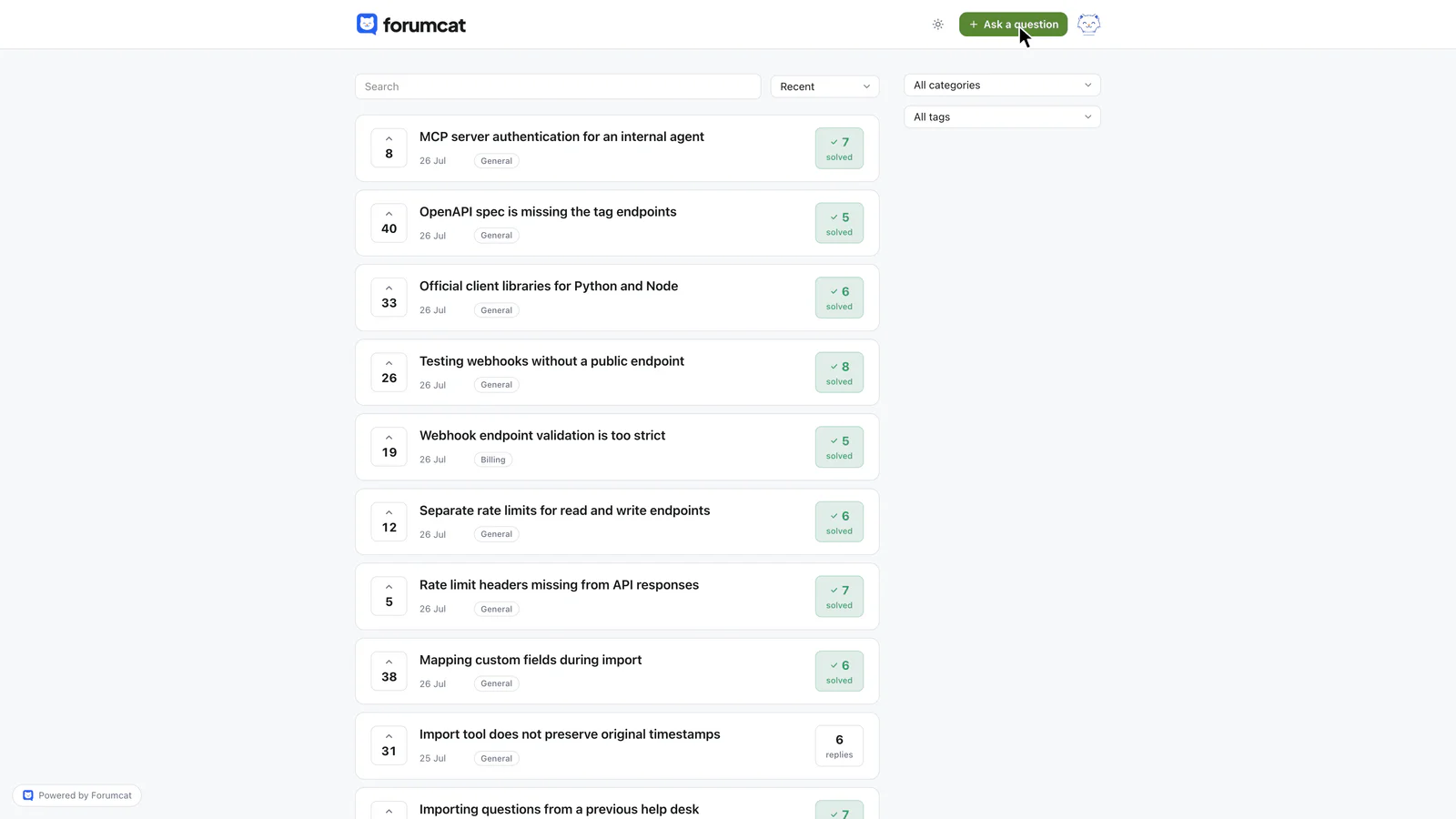
The support and Q&A type: a list of questions, each one a page.
Why the support and Q&A type cuts tickets
This type lowers volume for three reasons, and all three come from the same place.
The questions arriving are the same questions your inbox already gets. Nobody has to invent topics. The answers are written by people who know the product, so a reader can act on them. Each answered thread keeps answering after that, without anyone touching it again.
Here is made-up arithmetic you can check against your own inbox. Say 30 emails a week ask the same thing. Say each reply takes ten minutes. That is 300 minutes a week, which is five hours. One public thread with that title does the same job after you write it once.
Substitute your own two numbers. The count of repeat emails per week, and the minutes one reply takes. Multiply them, then divide by 60 for hours. That is the time one answered thread is working against.
Why the other five do not lower support volume
The other five types are worth running. They are worth running for other reasons.
Feedback communities produce a roadmap, which is the list of what you plan to build. Learning communities produce completions, meaning people who finished the material. Brand communities produce affection, and people who like you tell other people. Networking communities produce introductions between members. Peer discussion communities produce a place people want to come back to.
None of that is deflection. Deflection means a customer got their answer without writing to you. A busy feedback board can even raise your ticket count, because people who post ideas also ask questions. The type is doing a different job.
Running one space with two jobs
Most companies want more than one of these. That is fine, with one rule: one space has one job at a time.
You can run a support and Q&A community and still take feedback in it. Keep them in separate categories, where a category is a named group of threads on one topic. Someone looking for how to change their card should not scroll past twelve feature ideas to reach it.
Two jobs mixed into one list means neither list scans. A person scanning for an answer gives up quickly. A product manager scanning for ideas gives up too. Separate the shelves and both readers find what they came for.

One space, one job, sorted by the words customers use.
The same rule applies to who can see what. Some companies run one public space for answers and one members-only space for deeper talk, which is covered in public and private communities compared.
How to pick in one pass
Pick by the outcome you want first, then shop for software. The type decides the tool, not the other way around.
If your inbox has the same twenty questions every month, pick support and Q&A. If you want to know what to build next, pick product feedback. If you want people to meet each other, pick professional networking. If you are teaching something, pick learning. If you want a place people enjoy being, pick brand or peer discussion, and plan for the weekly presence that takes.
Write the choice down in one sentence before you look at any community platform. Then judge each tool against that sentence. Skip this step and a community can end up busy and useless at the same time.
Forumcat is built for the first type only. It is a hosted public question and answer portal on your own domain or a Forumcat subdomain. Customers ask, staff answer, and the asker or a staff member marks one reply as the accepted answer, which pins under the question. Search covers every question and answer. Every answered public question ships QAPage structured data, which is extra code telling a search engine the page is a question with an accepted answer.
Forumcat does not do chat, courses, or feedback boards. If you want a hangout, pick something else from the list above. If you want a support forum where repeat questions turn into pages, that is the job it does. A portal on a Forumcat subdomain is $9 one time, with a 7-day free trial and no card.
Keep reading: how to build a customer community and a Discord alternative for customer communities.