Find the questions you answer more than twice. Write each one as a public page, in the customer's words. Make those pages searchable. Link to them when the same question arrives again. The same question over and over stops when the answer is easier to find than it is to ask for.
You do not need a research team. You need last month's support mail, a notepad, and a place the next person can search.
What an answer base is
An answer base is a set of public pages. Each page answers one real question. Anyone can search those pages without an account.
A help center is a set of articles grouped by topic. The unit in an answer base is a question, like "card declined". People type those words into search. They find pages that start with the same words.
The pages have to be public. If a later customer cannot open them, you will type the same answer again. Reading and search should not require a login. Sign-in can wait until someone wants to post.
Those public pages are customer questions and answers living where later people can find them. Each thread is one question on one page, with one trusted reply.
Find the questions that repeat
Open last month's support mail. Support mail is every message customers sent to your help address. Walk through it with a notepad. Mark each question you answered more than twice.
Twenty minutes with a notepad is enough for this step. You already know the repeats. This pass is only to write them down.
Write each line in the customer's words, not your product's words. Write "card declined". Do not write "payment method update failure". People type the first phrase, and they do not type the second.
Group near-matches on one line when the answer is the same. "My card was declined", "payment failed", and "charge did not go through" are one group. Keep the wording that showed up most.
Stop when you have a list. Ten lines is plenty for a first pass. You will add more later from searches that found nothing.
Count what each repeat costs
Pick one line on the list. Count how many times it arrived in a week. Multiply by the minutes you spend on one reply.
Say 30 mails a week ask the same thing, and each reply takes ten minutes. That is 300 minutes a week, which is five hours for one question.
Do this for each line. Rank the list by that number. Do not rank by how annoying the question feels. A short, polite question that arrives 30 times costs more than a long, rare one.
Write the hours next to each line. That number tells you what to write first. Start at the top.
Write the answer once
Take the highest line. Turn it into a public page.
Title it in the words a customer would type. "How do I fix a declined card" is a title. "Payment troubleshooting" is a filing label. People search for the first one.
Write two or three sentences as the question body. State the problem the way the customer stated it. Then write the full answer in plain steps. Name the buttons and the screens, and say what success looks like.
Mark one reply as the accepted answer. The accepted answer is the one reply later readers should trust. It pins under the question, and the thread then shows as solved. A solved thread is a page a later customer can follow without guessing.
Strip account numbers, names, and emails before you publish. The next reader needs the steps. They do not need someone else's details.
If the case is only about one account, keep it private. A private question is visible to the asker and staff only. Public pages are for answers that help the next person too.
Make the pages findable
Writing the page is not enough. If nobody can find it, the next customer will ask you the same question.
Three things make a page findable. The title uses the customer's words. The page is public, so search engines can read it. The search box on your own site covers it.
Search engines are the tools, such as Google, that people use before they write to you. If the page is locked, those tools cannot show it. If the title uses your internal name for the problem, the search will miss it.
The search box on your site has to cover every question and every answer. A title-only search misses the useful words that live in the reply.
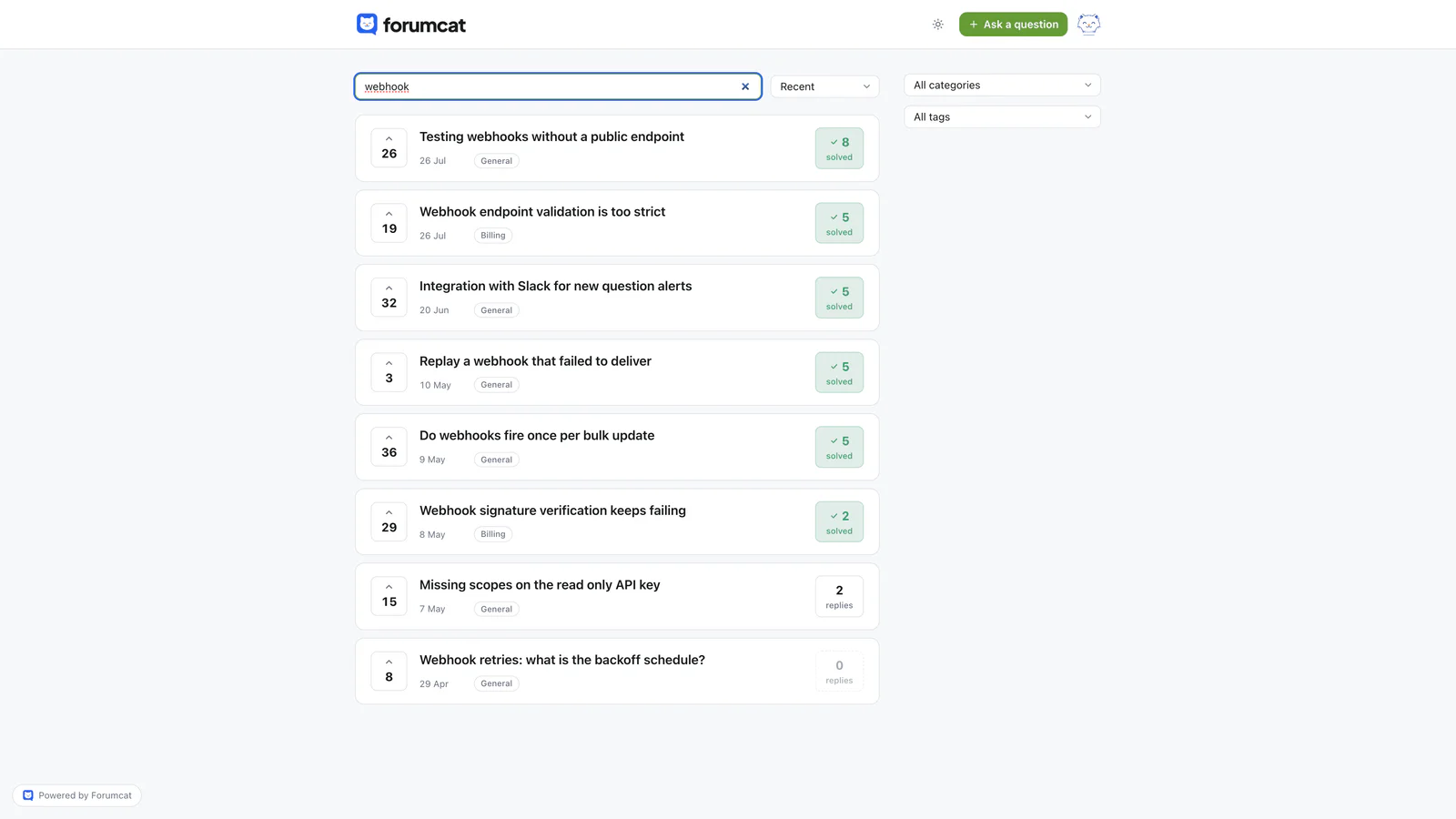
Search has to reach every answer, not only the titles.
If you already run a hosted support forum, this is the job it is for. Each answered thread is a page, and search has to reach it.
Send people to the page, then write what search missed
When the same question arrives again, answer it in public first, then send the person the link. You still helped them. You also left the page in front of the next person.
Put the link in your auto-reply. An auto-reply is the automatic message your mail tool sends when someone writes in. One line is enough. Tell them they can search past answers at that address, and that the accepted reply is the one that worked.
Put the same link in your email signature, and in the help menu on your site. Those are the three places customers already look.
Do this every time the question comes back. The habit is what turns pages into deflection. Deflection means the person finds the answer and does not open a new ticket. A page with no link in front of it will sit unused.
This is the same work as cutting support tickets with a self-service forum. The public page holds the answer. Sending the link is what makes people use it.
After you have a few pages, watch the searches that return nothing. Those are empty searches. An empty search is a query that found no useful thread.
The person already typed the words they use. Write that question next, in those words. Then write the answer and mark it solved.
This research costs nothing. You do not guess what to document. The failed search tells you exactly what to write next.
If your tool does not show empty searches, keep a running note. Add a line when you or a teammate cannot find an answer. That list is the same signal.
Say three people a week search for "change the card on file" and find nothing. Each then emails you, and each reply takes ten minutes. That is 30 minutes a week on one missing page. One public thread, titled in those words, does that job after you write it once.
What does not cut the repeats
A longer FAQ page does not cut the repeats. An FAQ page is one long list of questions on a single web address. People cannot search one item on that list. Search engines treat the whole page as one document.
A canned reply does not cut the repeats either. A canned reply is a saved snippet you paste into email. Some teams call this a macro. A canned reply makes each repeat cheaper to answer. It does not make the repeat rarer. You still receive the mail, open it, and paste the snippet.
A knowledge base article that nobody links to has the same problem. A knowledge base is a set of help articles your team wrote. The article can be correct. If customers cannot find it, and you never send the link, the mail still arrives. The longer split between articles and threads is in the knowledge base vs community forum comparison.
A public searchable thread avoids those traps only if people can find it. Forumcat is a hosted Q&A portal on your domain. Search covers every question and every answer. While a customer types a new question title, the portal suggests existing threads that already answer it. That helps stop a duplicate before it is posted. A duplicate is a second copy of a question you already answered.

The duplicate is stopped before it is posted.
The asker or a staff member marks one reply as the accepted answer, and it pins under the question. Forumcat does not import your existing help articles. Import here means copying old articles in automatically. The first pass of writing is manual. There is no AI that writes the answers for you. AI here means software that tries to draft the reply. You still write the first answers. After that, the pages answer the next person who searches.
Keep reading: how a self-service forum cuts support tickets, the knowledge base vs community forum comparison, and forum vs FAQ page.