A private email answer helps one person once. A public answer helps everyone with the same problem, including the people who never write in. Email support is still needed for anything about one customer's account. Most teams should do both. Keep email for the private half of the work. Move the repeating half into public. This post covers how that works, the objections worth taking seriously, and the line for what must never be public.
The arithmetic of one answer
Here is an example. The numbers are made up, and they are only there to show the shape.
Say 30 emails a week ask the same thing. Say each reply takes ten minutes. That is five hours a week, every week, for as long as the question keeps arriving. Nothing piles up from it. Next week you type the same answer again.
Now write that answer once in public. Say it takes twenty minutes, because you are careful with it. After that, the page does the work. Someone searches, finds it, and reads it, and you typed nothing that day.
Those figures are an example, not a measurement, and your own numbers will differ. Read back through your last week of email and mark the questions that repeat. If you want to put a cost on each one, what a support ticket costs walks through it.
What email support does better
Email is better at several real things. Those come first here, so the rest of this post is easier to trust.
One customer's account belongs in email. Their plan, their invoice, their data, their sign-in trouble. None of that helps a stranger, and some of it should never be visible to a stranger at all.
Refunds belong in email. So does anything under a contract, where the answer depends on terms you agreed with that one customer.
An angry escalation belongs in email. An escalation is a complaint that has moved above normal support. A person who is upset usually wants a private room.
Long conversations belong in email too. Some problems take eight or nine turns to work out. A forum thread can carry that, but email carries it better.
So keep the inbox. The question is which answers should also exist somewhere a stranger can find them.
Four things a public answer does that email cannot
The first thing is that the next person searching can find it. Someone types their problem into a search engine at eleven at night. Your page comes up. They read it and carry on with their day. Nobody was on shift, and no email was ever sent.
The second is that another customer can correct or extend it. A member replies with the version that worked on their setup. You get a better answer than the one you wrote, and you did not have to write it.
The third is that a prospect can read it before buying. A prospect is a person thinking about buying from you. They can see how your questions get answered, and how fast. That builds more confidence than a page of claims does.
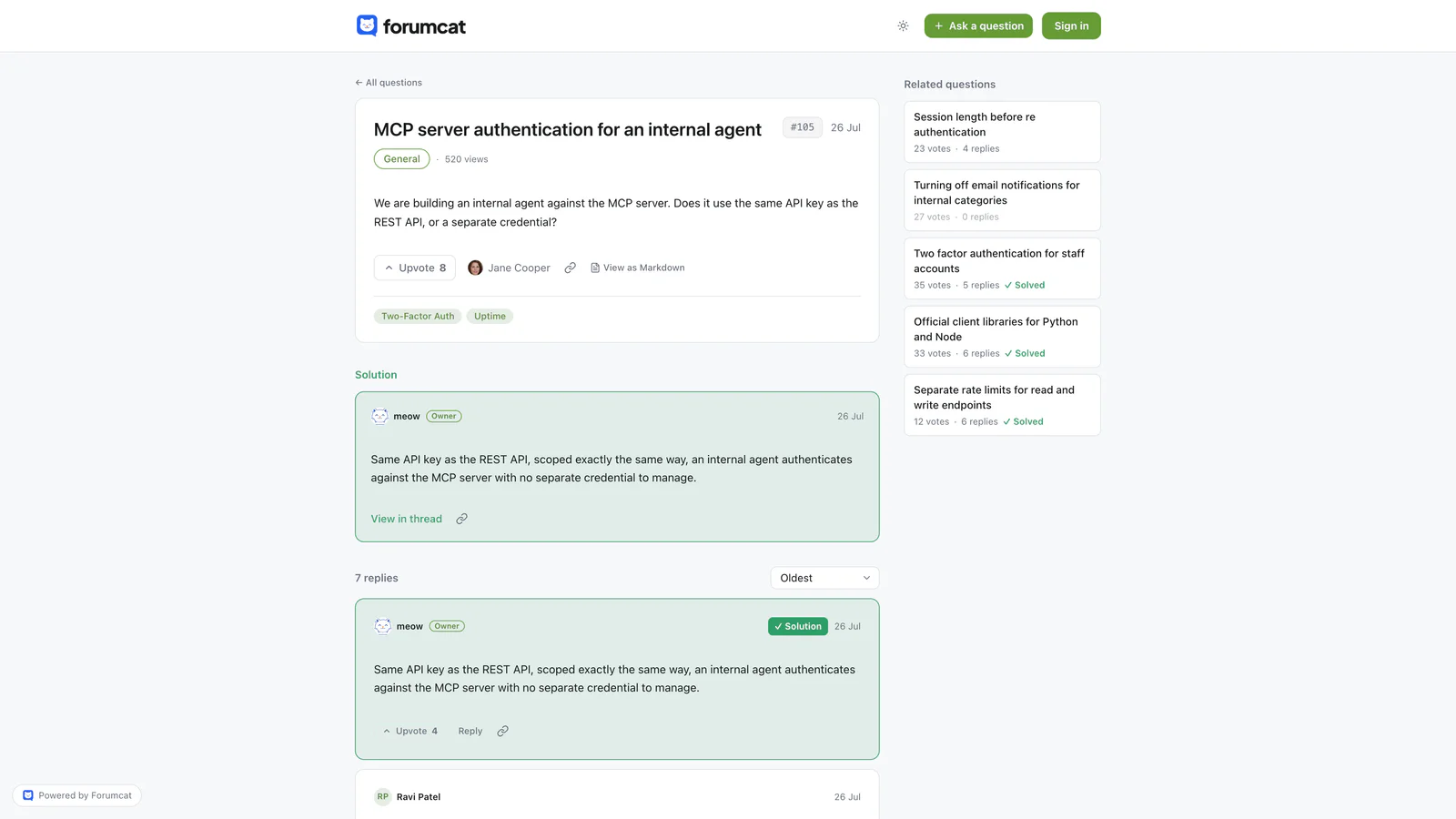
The answer is on the page before anyone signs in.
The fourth is that your own team can link to it instead of retyping it. The next time the question arrives by email, the reply is one line and a link. Nobody writes the same paragraph from memory, so everyone sends the same answer.
All four follow from the answer being on a page that anyone can open.
What builds up over time
An inbox is a stack that empties. A forum is a shelf that fills. The same typing produces a different thing at the end of the year.
The work feels identical while you are doing it. You read a question, you think, and you write a careful reply. In one case the reply goes to one address and is gone. In the other it goes onto a page with a web address, and the page stays.
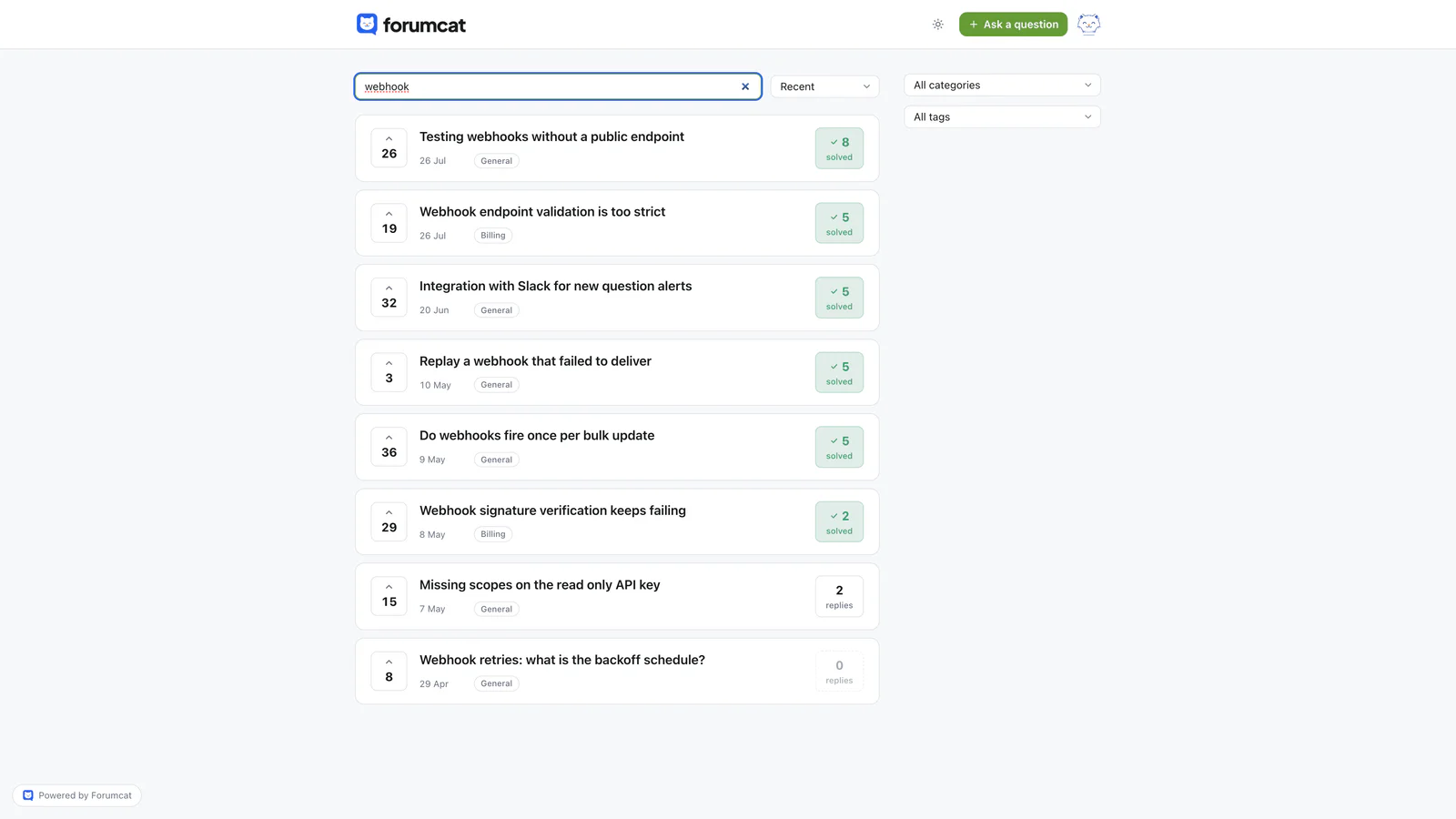
The shelf that fills, one answered question at a time.
After six months of this you have something you can use. New staff read the old threads to learn the product. You find out which parts of the product confuse people. You send links instead of paragraphs. If you want that stack of answers to actually cut your email volume, a self-service forum that reduces support tickets covers how to get there.
The objections, one at a time
Our complaints will be public. They already exist. Customers write them to you, to their colleagues, and sometimes to social media. Publishing your answer is the part that changes the impression. A complaint with a clear, quick, honest answer under it reads better than the same complaint with silence under it.
Competitors will read it. They will read it either way, and they can sign up for your product today. What a competitor mostly learns from your forum is that you answer people, which is not a secret you were keeping.
Our answers are wrong sometimes. Then they are wrong in public, where a customer or a colleague notices and says so. In an inbox, a wrong answer goes to one person and nobody else ever sees it. A public mistake gets fixed. A private one sits there.
Customers want privacy. Some do, for some questions. That is a real objection, and it is the next section.
The line between public and private
Here is a rule you can apply today. If the answer would help a stranger, it belongs in public. If the answer needs their account details, it belongs in private.
Most questions split down the middle. Someone asks why their invoice looks wrong. Half of that answer is how invoices are calculated, which helps everyone. The other half is what happened on invoice 4471, which helps one person. Answer the general half in public and send the account detail privately.
Some things should never be public at all: account numbers, invoices, home and billing addresses, security reports until the hole is fixed, and anything about a named individual, staff or customer. Those never go on an open page.
Clarity about that line makes a public forum comfortable to run. Private versus public customer communities goes deeper into the trade if you are still deciding.
How to move without breaking anything
Keep the email address. Do not remove it, do not hide it, and do not announce a migration. Nobody likes being told that the way they reached you has changed.
Instead, change what you do with the repeats. When a question arrives that you have answered before, write the answer in public first. Then reply to the email with a short note and the link. The customer gets the same answer at the same speed. The difference is that the answer now exists somewhere.
Do not force customers to post in public. Some will keep emailing forever, and that is fine. Over time, more people find the page before they write to you, because searching is faster than waiting for a reply. The forum grows because it is quicker for them.
Give it a few months before you judge it. The first twenty threads feel like extra work. They are the ones the next hundred answers link to.
Where Forumcat fits, and where it does not
Forumcat is a hosted customer questions and answers portal. Customers read and search it without an account, so the answers work for the people who never write in. Asking a question needs a sign-in, by magic link, six-digit email code, or Google. A magic link is a sign-in link sent to email, so nobody has to invent a password.
A question can be made private, so only the asker and staff see it. That is where the account half of a split question goes. Every answered public question ships QAPage structured data. Structured data is a small block of machine-readable detail in the page, and QAPage tells a search engine that the page is a question with an accepted answer.
Forumcat does not receive email. It does not connect to your help desk and it does not replace one. It is the public half, sitting beside whatever inbox you already run. A hosted support forum on a Forumcat subdomain is $9 one time, with a 7-day free trial and no card.
Keep reading: how a self-service forum cuts support tickets and what a customer portal is.