A knowledge base answers the questions you predicted and wrote down. A community forum answers the questions customers actually ask, including the ones nobody on your team saw coming. Both cut tickets. If you can only run one, decide by who writes the content. In a knowledge base that is always your team. On a forum the customer writes the question, and your team writes the answer once, in public. Most teams end up wanting both. Pick the one that fits how your customers behave today, then add the other.
The real difference is direction
A knowledge base is a set of articles your team writes and keeps. Someone decides a topic matters, writes the page, adds screenshots, and files it under a category. The work runs top down. The order is tidy, the tone is yours, and nothing goes live until you approve it. When the product changes, a person has to go back and edit the page by hand.
A forum runs the other way. A customer posts a question in their own words, and someone on your team answers in public. Nobody planned that page. It exists because a real person needed it. The thread stays up, the next customer finds it, and the archive grows one question at a time. You never sit down to write it. You just answer.
A knowledge base covers what you wrote, and nothing else
The article model has a quiet cost. Every new edge case needs someone to spot it, agree it deserves a page, write the page, and publish it. That is four steps between a customer's problem and a page that solves it. Most of those steps wait on a week nobody has.
On a forum the first step is free. The question writes itself the moment a customer types it. Your job shrinks to the answer, which you were going to write anyway in a private reply to that one person. The only change is that the reply is public and stays up.
Try the math. Say twelve people a month hit the same odd setup problem. With articles only, that is twelve private replies until someone finally writes the page. On a forum, person one asks, you answer, and people two through twelve find the thread. The same work, done once. That is the whole idea behind a self-serve forum that cuts ticket volume.
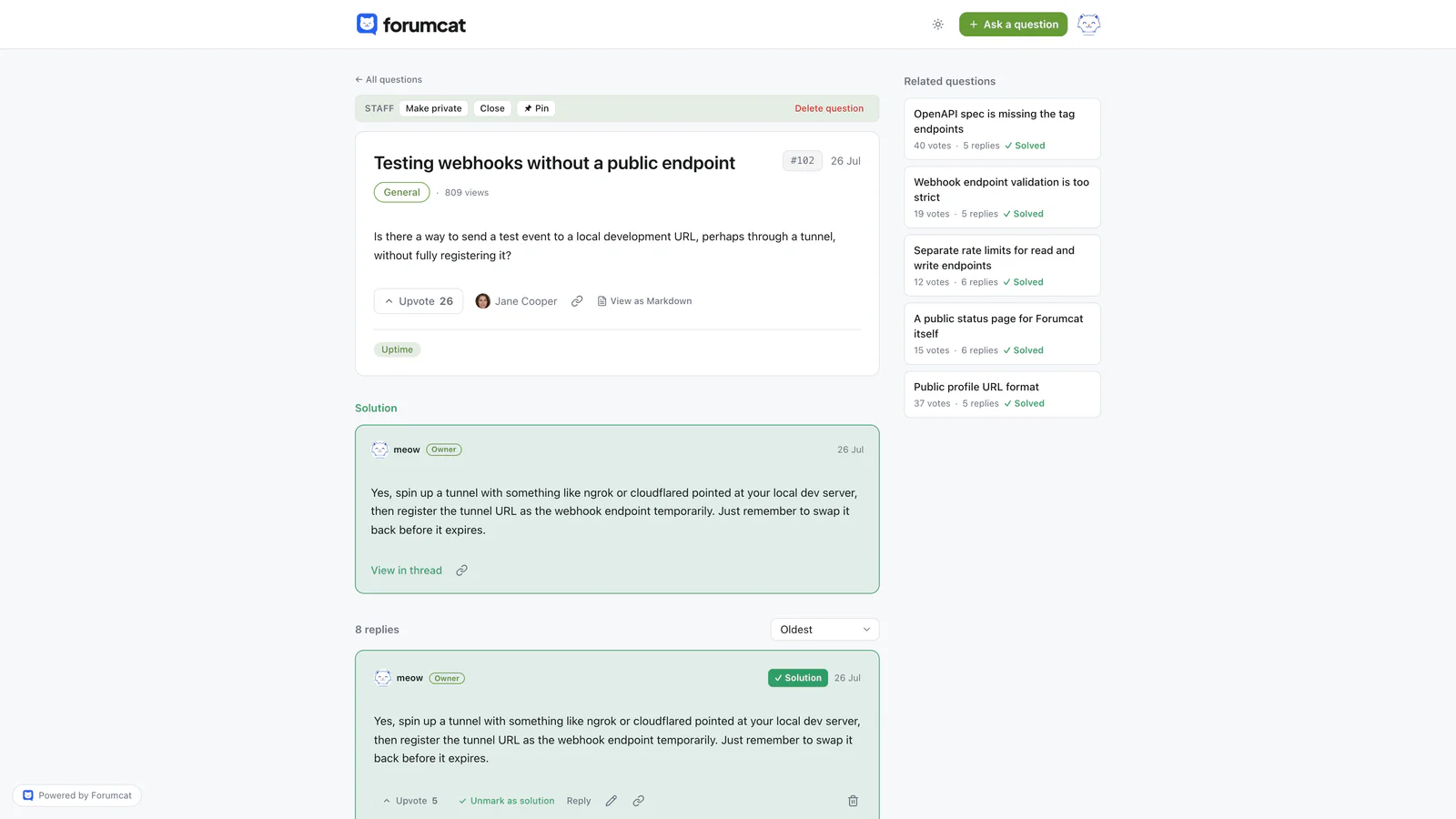
The archive grows along what customers ask.
Both go wrong, in different ways
Knowledge base articles go stale silently. A screenshot shows a button that moved last spring, and the page keeps ranking, keeps getting read, and keeps sending people to support with a new problem on top of the old one. Nothing on the page tells the reader it is out of date. Someone has to remember.
Forum threads age in the open. Every post carries a date, so a reader can see the answer is from two years ago and read it with care. When something changes, a customer often says so in a follow-up reply, and your team can post a correction under the same question. Old threads get repaired instead of quietly rotting.
Forums have their own failure modes, and they are real. An empty forum helps nobody and looks abandoned, so the first few months need your team to seed and answer. And customers sometimes post confident answers that are wrong. That needs a person watching, and a way to mark the correct reply so the right answer sits at the top. Most tools let the asker or your staff mark one reply as accepted, which fixes the ranking problem inside a thread. It does not fix the watching problem. Somebody on the team has to read the new posts.
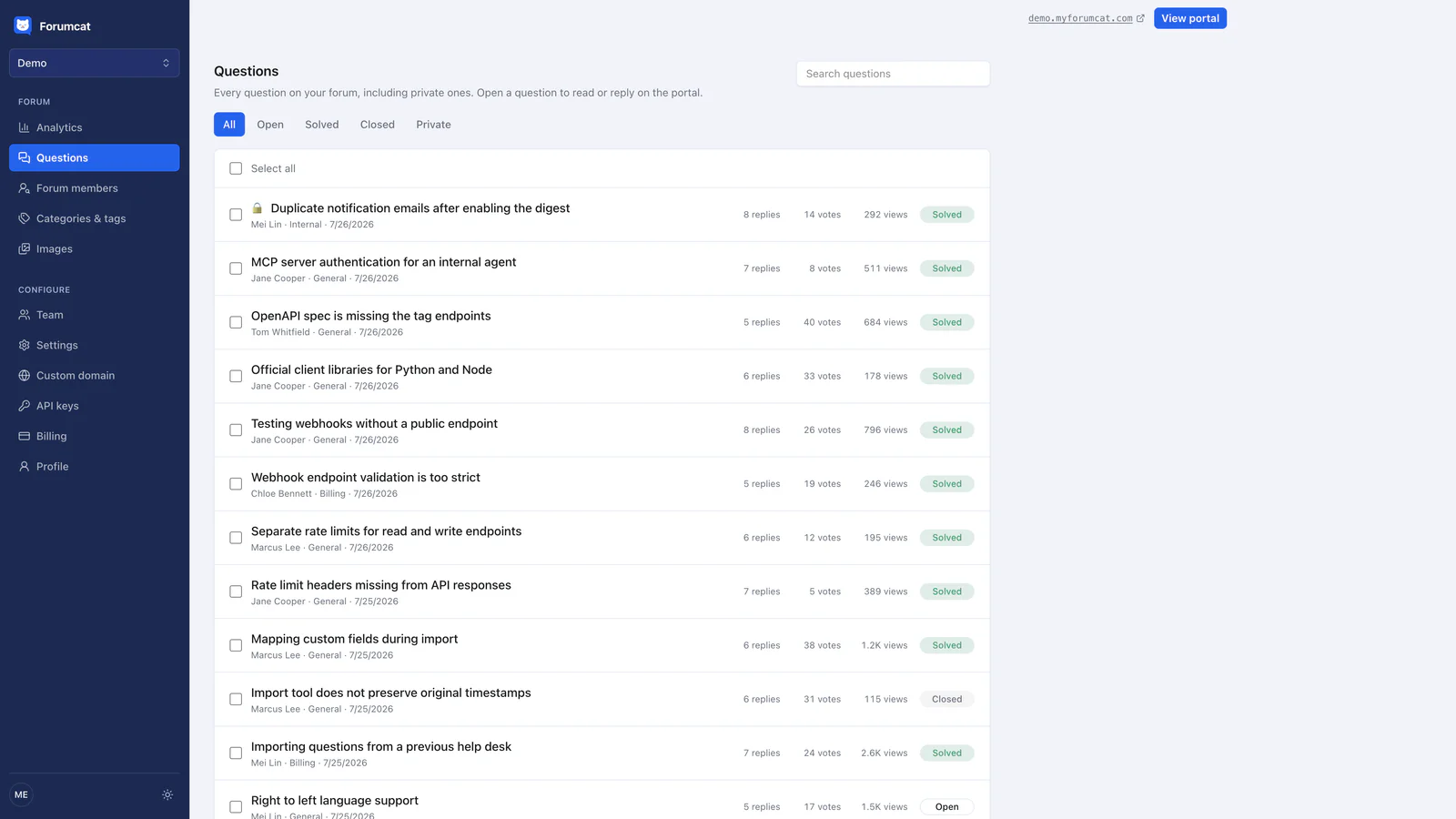
A forum needs a moderator, and the dashboard makes it a small job.
Customers start in Google, not in your search box
Almost nobody opens your site and hunts through a docs menu. They type the problem into a search engine, in their own words, usually as a question. "Why does my export come out empty" is a search. It is rarely an article title.
Forum threads match that shape by default, because a customer wrote the title. Article titles get written by people who know the product well, which is exactly why they use the internal word for the feature instead of the word the customer would use. You can fix that in articles with care and keyword work. On a forum you get it free.
This is where a hosted Q&A portal earns its place. On Forumcat, every answered public question ships QAPage structured data, so a search engine can read the page as a question with an accepted answer under it. And while a customer types a new title, the portal suggests threads that already answer it, so a good share of duplicates never get posted at all.
Side by side
The knowledge base wins the top of that list on control and on teaching. If you need a twenty-step setup guide with annotated screenshots, write an article. Nobody wants to read that as a forum reply. If you are weighing alternatives to knowledge base software, that is the trade to keep in mind. You give up some polish and gain coverage you could not have planned.
How to choose
Choose a knowledge base first if your product needs long tutorials, if your customers rarely talk to each other, or if you are pre-launch and have no customers to ask questions yet. Ten solid articles beat an empty forum every time.
Choose a forum first if the same questions keep repeating in your inbox, if your customers phrase things in ways your docs never will, or if your product is broad enough that you cannot guess what people will hit. Also choose it if writing has stalled. A forum turns support replies you are already writing into pages, so the archive grows even in a week when nobody has time to write.
Run both once either one is working. Articles carry the paths you can plan, threads carry everything else, and a help center that holds both covers more ground than either alone. Many teams link out from an article to the thread where the awkward version of the question got answered.
Starting the forum side is cheap enough that it is not much of a bet. A portal on a Forumcat subdomain is $9 one time, and the trial runs 7 days with no card. Give it a month of real questions and count how many threads get read more than once.
Keep reading: what a customer portal actually is and how a self-serve forum cuts support tickets, and how to build a customer community, and forum vs FAQ page.