The short answer is simple. Find the questions your customers ask most, answer each one in public, and make those answers easy to find. That is the whole method. When you answer a question in a private email, the answer helps one person and then disappears. When you answer it on a public page, it keeps working for every person who asks next.
Most support inboxes are full of repeats. So this one change takes real volume off a small team, without hiring and without buying a big new system. Here is how to set it up in about a week.
What ticket deflection means
Ticket deflection means answering a question in public once, so the next person with the same question never has to email you.
The customer still gets the answer. They just get it in seconds, at 11pm, without writing a message and waiting until morning. That is why a deflected ticket is a win on both sides. Your team writes one careful answer instead of forty rushed ones, and the customer stops waiting.
Deflection is not about hiding your contact form. If someone cannot find the answer, you want them to reach you fast. The goal is to make the easy questions easy, so your real support time goes to the hard ones.
Why the same questions keep coming back
Open your support inbox and read the last fifty messages. You will probably see the same handful of questions again and again, in slightly different words.
There is a simple reason. New customers all walk the same path through your product, and they get stuck at the same steps. The person who signed up today hits the same confusing screen the person who signed up last Tuesday hit. Nothing about that repeats itself by accident.
Email answers do not stop the cycle, because email is private. Your reply goes into one inbox and stays there. Nobody else can read it, search it, or link to it. If the person who wrote that great answer leaves the company, the answer leaves too. You end up paying for the same work over and over.
Public answers behave the other way around. Write one, and it sits there and does its job every day without anyone touching it.
The math of one public answer
You do not need a study to see the size of this. Use your own numbers.
Say one common question reaches you thirty times a year. Each reply takes about ten minutes once you count reading the message, checking the account, writing a clear answer, and switching back to what you were doing. That is 300 minutes a year, or five hours, for one question.
Now say you have ten questions like that. Ten questions, thirty asks each, ten minutes an ask works out to about fifty hours a year. That is more than a full work week spent retyping things you already know.
Writing those ten answers in public might take twenty minutes each, so a little over three hours in total. Even if only half of your customers find the public answer and the rest still email you, you save around twenty-five hours in the first year. And the answers keep paying out in year two, when you write nothing at all.
Run this with your real numbers before you commit to anything. Whatever figure you land on, repeat answers will be among the most expensive things in your inbox, and they are also the easiest to remove.
What self-service needs to work
Plenty of teams write help pages and see no drop in tickets. Usually one of three parts is missing.
The first part is answers a search engine can find. Your customers do not start on your help page. They start in Google, and they type your product name plus the thing that broke. If your answer is not in those results, it might as well not exist.
The second part is search on your own site. Once someone lands on your portal, they should be able to type a few words and get the thread they need, without an account and without clicking through a menu of categories.
The third part is a way to ask when nothing matches. This is where most help centers stop. A help center covers the questions you predicted when you wrote it. A self-service portal built around questions also covers the ones you never thought of, because customers write those questions for you, in their own words. Their wording is often closer to what the next person will search for than anything you would have written. (If you are weighing the two formats against each other, we wrote a longer piece on how a knowledge base and a community forum differ.)
Forumcat is a hosted support forum built for exactly this job. Answered threads ship QAPage structured data, which is a small piece of markup that tells a search engine "this page is a question with an accepted answer", and anyone can read and search the portal without making an account.
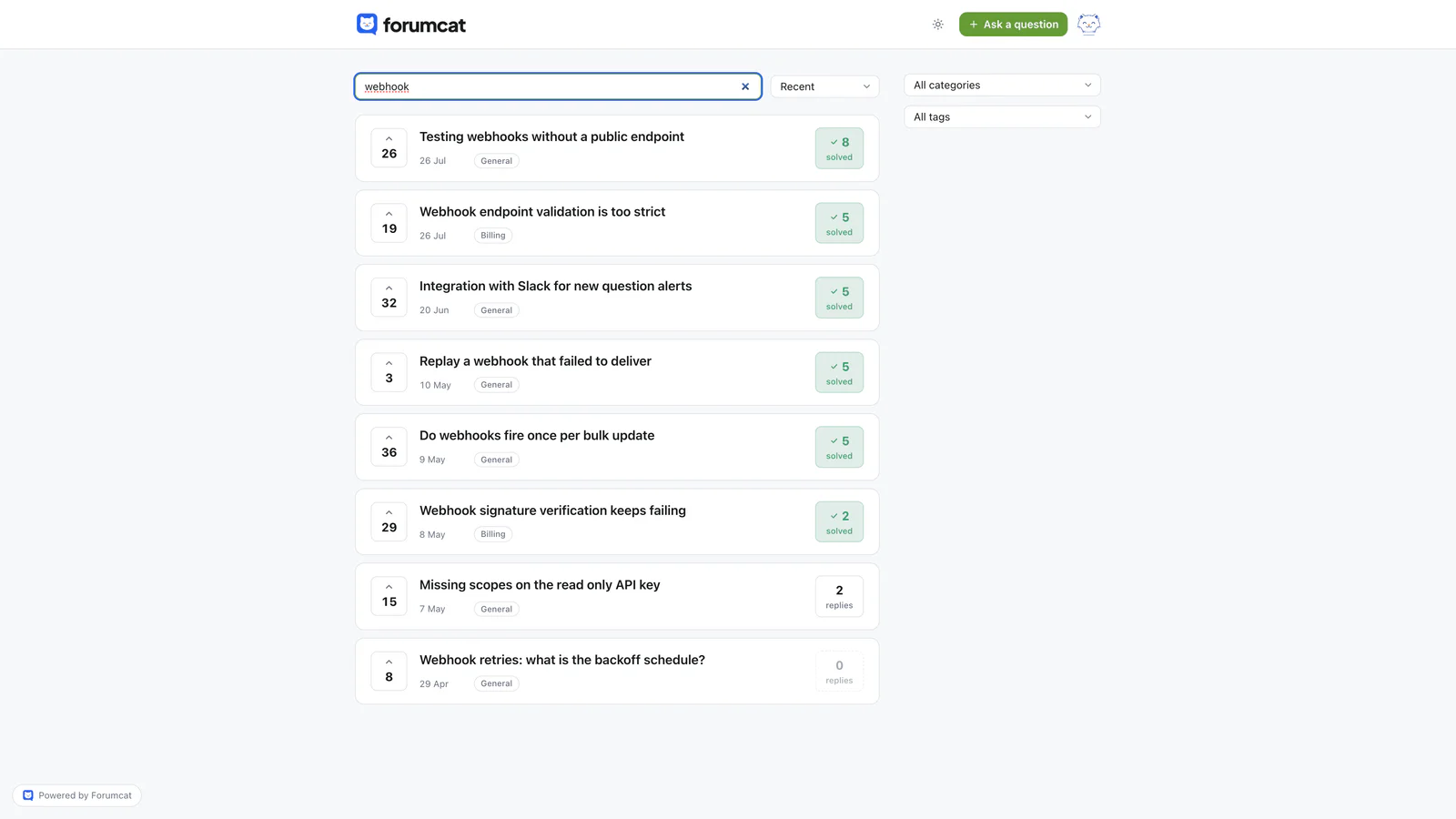
Customers search first; answered threads are what they find.
How to start deflecting this week
You do not need a project plan for this. Five steps, and you can do the first three in an afternoon.
Pull your last fifty repeat questions. Scroll back through the inbox and copy each question into a list. Group the ones that are really the same question. Sort the list by how often each one shows up.
Post and answer the top ten yourself. Write them as real questions in the customer's words, not as tidy headings like "Billing overview". Post each one, then answer it properly. Yes, you are writing both halves. That is normal for a new portal, and it seeds the search index so the next visitor finds something.
Put the link everywhere email lives. Your signature, your auto-reply, your contact page, the footer of your product emails. Nobody uses a self-service page they have never seen.
Mark the correct answer on every thread. One reply gets marked as the accepted answer, and it pins under the question so a reader knows which reply to trust. A thread with five replies and no marked answer makes people email you anyway.
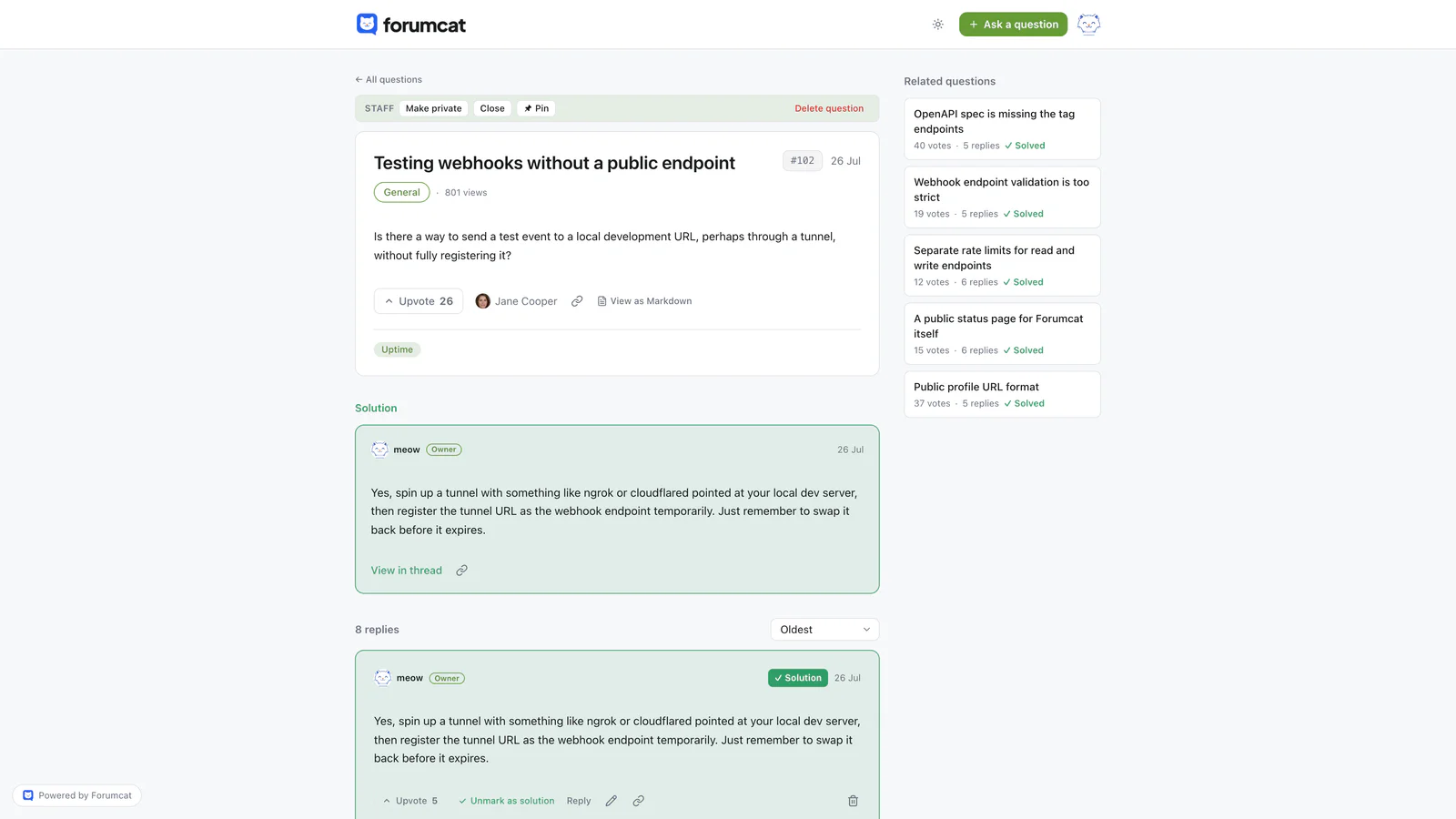
One accepted answer, pinned, findable forever.
- Watch the searches that return nothing. Empty searches are a list of the answers you still owe. Write those next, and you keep deflecting tickets month after month instead of once.
One more thing that keeps a portal clean: while a customer types a new question title, Forumcat suggests existing threads that already answer it. Many people read the suggestion and never post, which stops duplicate threads before they exist.
What self-service will not fix
Self-service does not replace a help desk, and you should not plan for it to.
Billing problems need someone to look at an account. Account-specific issues ("my export failed last night") need someone with access to logs. Bugs need someone to file them. Angry customers need a person, quickly. None of that belongs on a public page, and pushing it there makes the experience worse.
What self-service removes is the repeats. That is the layer sitting on top of your help desk, catching the easy questions before they turn into tickets, so the tickets that do arrive are the ones that deserve a human. If you are also picking support tools right now, our notes on what to check before buying help desk software cover how the two fit together.
Cost is not usually the blocker either. A Forumcat portal on a subdomain is $9 one time, and the trial runs seven days with no card, so you can test the top ten answers before you decide anything.
Keep reading: what to check before buying help desk software and knowledge base vs community forum, and running a customer community in 15 minutes a day, and how to measure ticket deflection rate, and how to reduce repeat questions.