Cost per ticket is your fully loaded support cost for one month, divided by the tickets your team handled that month. Fully loaded means salary plus payroll costs plus tools. That is the whole formula. Your own number is the only one that belongs in your budget. Working it out takes about ten minutes, and this post shows every line so you can check it.
Every figure below is a made-up example input. It is labelled as one. Swap in your own numbers as you read.
Why this post uses no outside numbers
Published cost-per-ticket ranges come from companies of different sizes, with different channels and different definitions of a ticket. A number built on someone else's definitions cannot be defended in your budget meeting.
So there is no benchmark here and no industry average. There is a method, and the arithmetic is on the page.
What counts as one ticket
A ticket is one customer request that a person on your team has to handle. Count requests, not messages.
An email thread with four replies is one ticket, not four. A phone call is one ticket. Two customers with the same problem are two tickets, because two people had to be helped.
Write your definition down before you count. Then use the same definition every month. A number that moves because the definition moved is not useful.
Step one, add up what support costs
The top of the fraction is everything you spend to answer customers in one month.
Add these four things:
- The salary of everyone who answers customers, for that month.
- Payroll costs on top of salary. Payroll costs are the extra amounts an employer pays per person, such as taxes, insurance, and benefits.
- The tools the support team uses that month, such as your help desk and your phone system.
- The share of an engineer's or a founder's month that goes to support.
If someone spends half their month on support, count half their cost. If a developer loses one day a week to escalated questions, that is one fifth of their month. An escalated question is one a support agent has to hand to someone more technical.
Include the founder's time even though it feels free. It is usually the most expensive hour in the company, because nobody else can do what that hour was meant for.
Step two, count the tickets in the same month
The bottom of the fraction is the number of tickets handled in the same month you just priced.
If you run a help desk, the report is already there. A help desk is the tool that turns customer emails into tracked tickets. If you work from a shared mailbox, count the threads instead.
Use the same month on both sides. A cost from March over a ticket count from June produces a number that means nothing.
Step three, do the division
Here is the example. One person answers support. They cost the company 5,000 for the month, including payroll costs and tools. They handled 500 tickets in that month.
The arithmetic runs like this.
- Support cost for the month: 5,000
- Tickets handled that month: 500
- 5,000 divided by 500 = 10
The cost per ticket in this example is 10, in whatever currency you pay people in. Put your own two numbers in those two lines and you have your figure.
If two people answer support, add both of their costs on the top line. The method does not change.
The cost of one minute
The per-minute cost is more useful than the per-ticket cost, because it prices any single question.
A full-time month is roughly 160 working hours. That is about 40 hours a week across four weeks. Keep using the same example numbers.
- 5,000 divided by 160 hours = 31.25 per hour
- 31.25 divided by 60 minutes = about 0.52 per minute
- A ticket that takes 20 minutes: 20 times 0.52 = about 10.42
Now you can price a specific question instead of an average one. Time three real replies with a stopwatch. Multiply the minutes by your own per-minute figure.
What your repeated questions cost
Repeats are the line you can act on.
Take your five most repeated questions. For each one, count how many tickets it caused last month. Then estimate the minutes one reply takes.
Stay with the example. Say 40 tickets a month ask how to change the card on file. Say each reply takes 15 minutes.
- 40 tickets times 15 minutes = 600 minutes
- 600 divided by 60 = 10 hours
- 10 hours times 31.25 per hour = 312.50
That is about 310 a month for one question. Over twelve months it is about 3,750. Repeat the calculation for the other four questions and you have the price of your top five repeats.
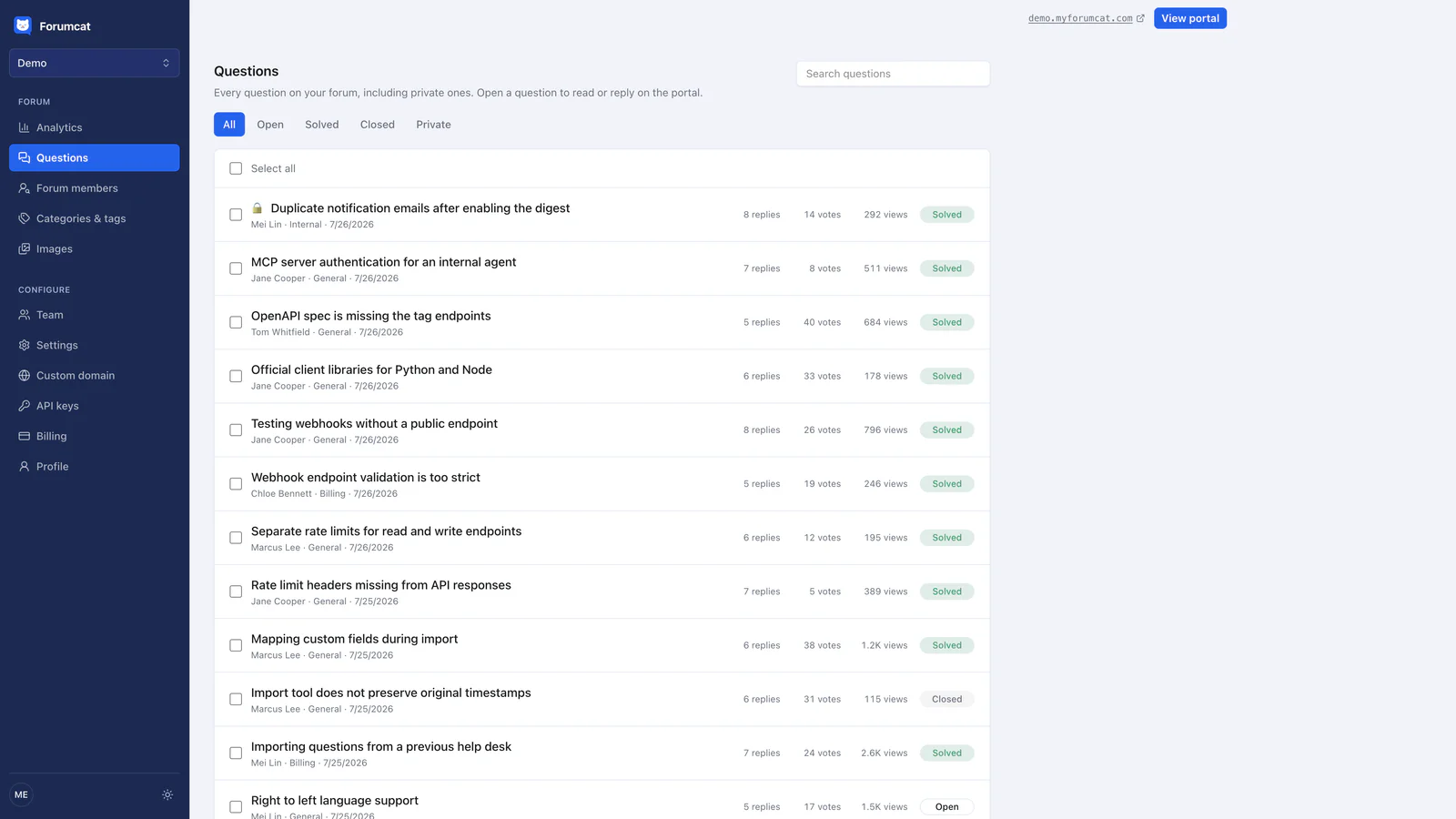
The repeated questions are the ones worth pricing.
These are made-up inputs, and the method is the point. Your ticket counts and your minutes will be different. The shape of the answer usually is not.
What the formula misses, and what lowers the number
The formula prices staff time. It misses four costs that are real and hard to measure.
The customer waiting is one. The answer nobody wrote down is another, because the next person has to work it out again. The third is the same reply written twice by two different people. The fourth is the sale that never happened, because someone could not find an answer at 11pm and closed the tab.
No numbers go on those four. Naming them is enough for a budget conversation.
The number falls when the ticket count falls. Cutting handle time works for a while and then stops, because a careful reply takes the minutes it takes. Answering a repeated question once, in public, has no such floor. The page you wrote in March is still answering in November, at no extra cost per reader. That is the case for customer self-service, which means letting people find the answer themselves instead of writing to you.
Forumcat is one way to do that. It is a hosted public question and answer portal on your own domain or a Forumcat subdomain. Customers ask in public, your team answers, and each answered thread becomes a page people can search and find. A portal on a Forumcat subdomain is $9 one time. A custom domain and higher caps are $99 per month. There is a 7-day free trial and no card.
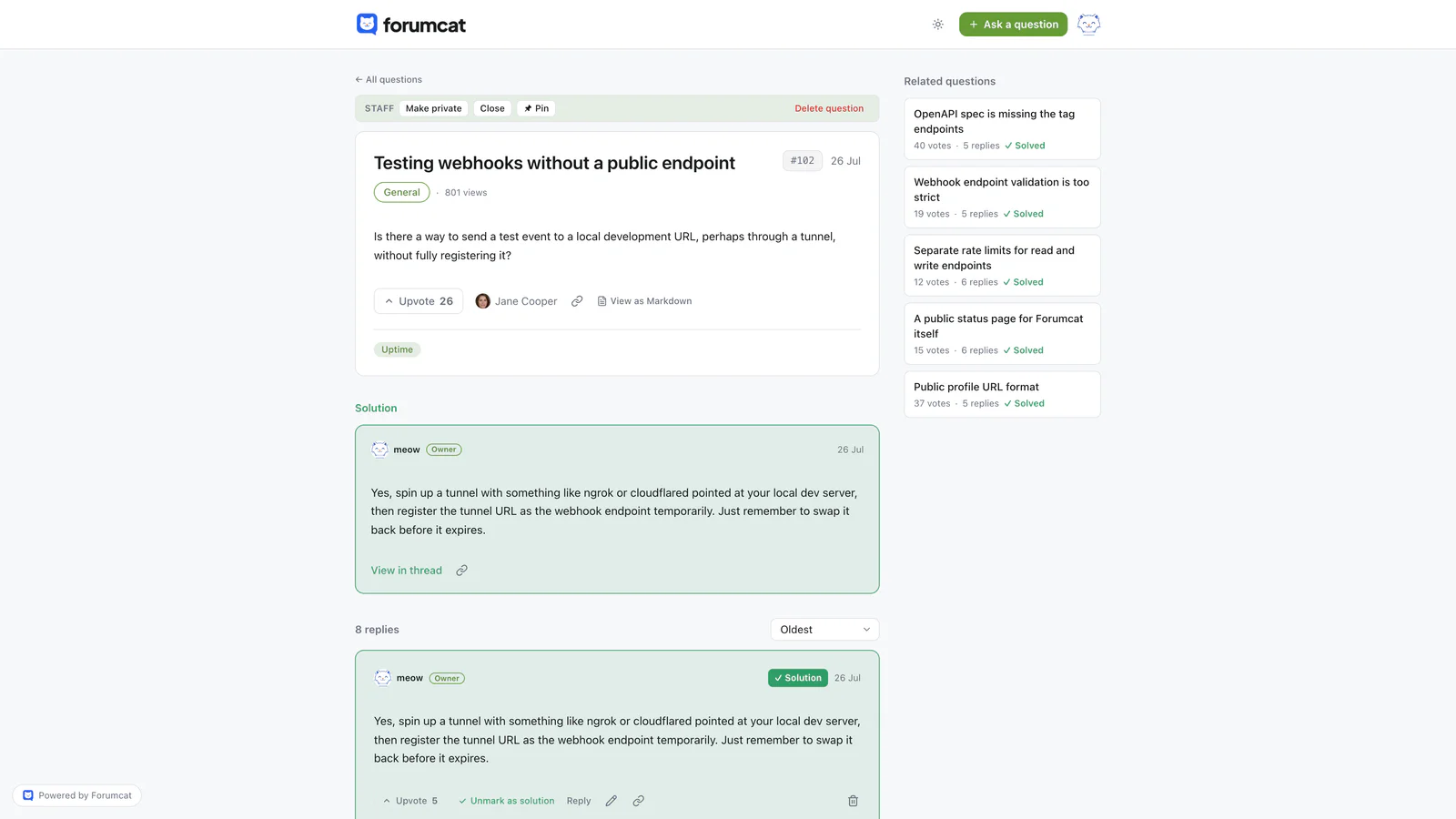
One answer, written once, at the top of the page for good.
Forumcat does not handle tickets and does not connect to your help desk. It does not measure your cost per ticket either. It works on the bottom of the fraction, by cutting how many tickets arrive. If you want the fuller version of that argument, see how a self-service forum cuts support tickets, and the page on running a support forum for what the setup involves. The share of questions answered without a ticket has its own measure, covered in how to measure ticket deflection rate.
Keep reading: what to check before you buy help desk software and how to cut support tickets with a self-service forum.